

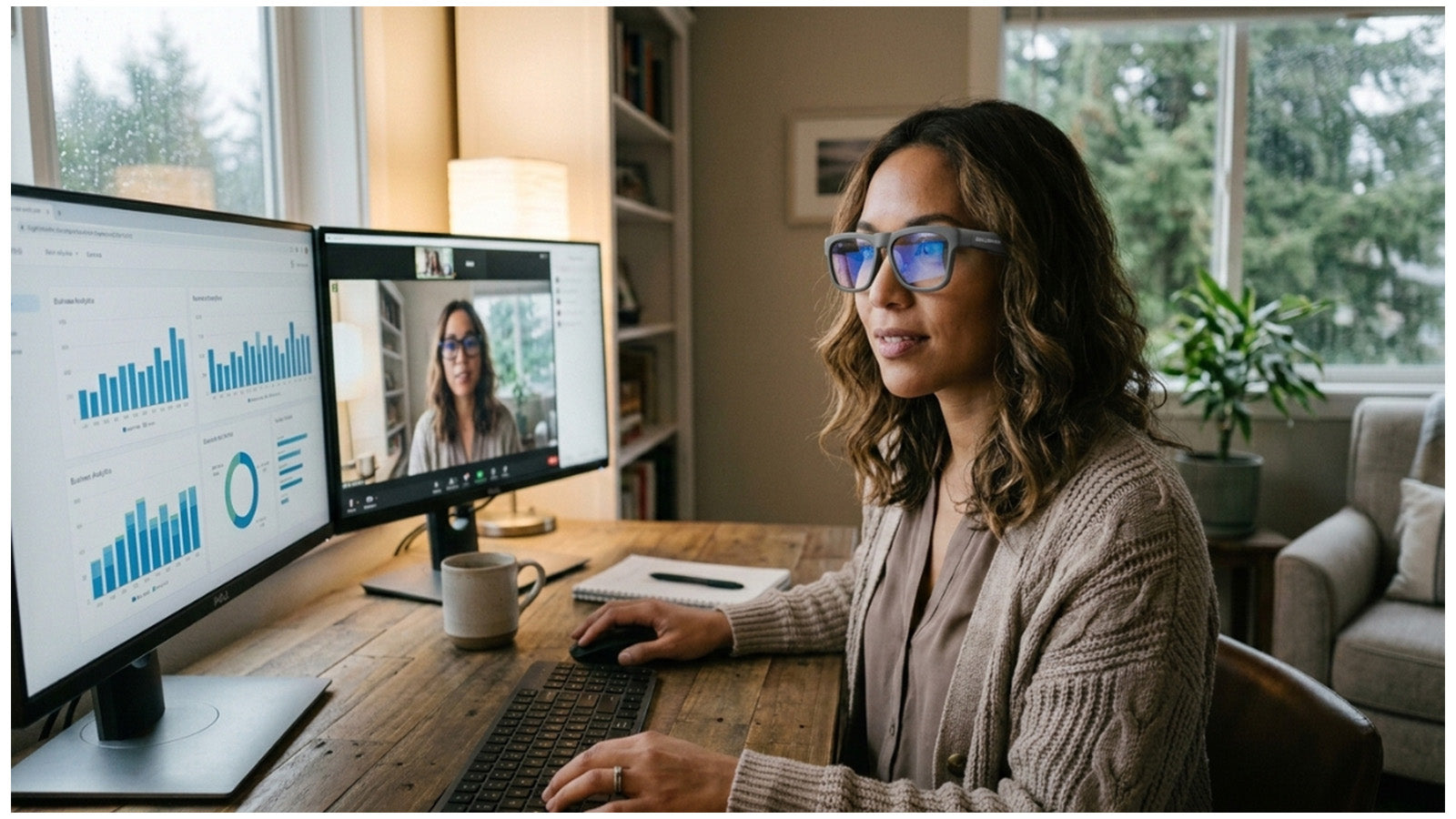
Remote work and screen time are inseparable. Blue light glasses benefits have become a genuine topic of interest for people who spend most of their working hours in front of a display, and for good reason. Add a built-in camera to the frame, and the same pair of glasses that protects your eyes also handles hands-free recording, meeting documentation, and tutorial capture without any extra gear. That is a meaningful shift in what everyday eyewear can do.
What Blue Light Glasses Actually Do for Your Eyes During Long Screen Hours
Most people who work remotely spend the majority of their day looking at screens. Monitors, laptops, phones, and tablets all emit blue light, a high-energy wavelength on the visible light spectrum that has been linked to digital eye strain, disrupted sleep cycles, and general visual fatigue during extended use.
The core blue light glasses benefits come from a filter built into the lens that reduces the amount of blue light reaching your eyes. This does not dim your screen or distort color significantly. It simply reduces the intensity of the wavelength that causes the most strain during long sessions.
What do blue light glasses do in practical terms for remote workers?
- Reduce eye fatigue during extended screen sessions
- Support more comfortable focus over long working hours
- Help maintain a more natural sleep rhythm by limiting blue light exposure in the evening
- Decrease the frequency of headaches associated with prolonged screen use
The benefits of blue light glasses are most noticeable for people who work six or more hours in front of a screen daily. For remote workers, that describes most weekdays.

Why Remote Workers Need More Than Standard Blue Light Glasses
A standard pair of blue light glasses solves the eye strain problem. But remote work involves more than just looking at a screen. It involves presenting, teaching, documenting, and collaborating, often simultaneously and across different tools.
Standard blue light glasses are passive. They filter light, and that is where their function ends. A pair with a built-in camera turns protective eyewear into an active productivity tool.
The gap becomes clear when you consider what remote workers actually do throughout the day. Recording a process walkthrough, capturing a tutorial for a teammate, or documenting a client meeting all require a separate device in a traditional setup. That means reaching for a phone, propping up a camera, or asking someone else to record while you work.
Camera-integrated blue light glasses eliminate that step entirely. The recording happens from your point of view, hands-free, while the lens continues protecting your eyes. Some models also integrate open-ear Bluetooth audio, allowing hands-free calls and voice assistant access throughout the day without anything sitting inside the ear. For professionals who move between tasks, this adds another layer of functionality to what is already sitting on their face.
For remote workers who produce content, train others, or need to document work sessions, that combination addresses multiple separate needs with one device.

How Built-In Cameras Make Remote Work Recording Effortless
The practical value of a built-in camera in a remote work context shows up most clearly in two specific scenarios.
Recording Meetings and Work Sessions
Most remote workers have experienced the friction of trying to record a meeting while staying present in the conversation. With camera glasses, recording starts with a single button press. An LED (light-emitting diode) indicator confirms the camera is running, and some models add vibration alerts for quiet physical confirmation without looking away from the screen.
File transfer is straightforward via USB-C, and some models support Wi-Fi (wireless network) transfer, sending footage directly to your phone without any cable. For remote workers who need to reference or share a clip quickly, that wireless option removes one more step from the process.
Creating Tutorials and Process Documentation
Camera glasses make tutorial recording feel more like simply doing the work. Your hands stay free, your perspective stays centered on the task, and the footage reflects the actual workflow rather than a staged version of it. That tends to be more useful for the people watching than anything filmed from a fixed camera angle.
Frame Designs That Fit the Home Office and Video Call Look
Wearable tech has historically struggled with looking like wearable tech. Current camera glasses designed for everyday use have moved past that. Frames are slim, lightweight, and built from materials like TR90, a flexible thermoplastic that holds its shape and stays comfortable through long wear sessions. The camera sits discreetly at the bridge of the frame, making it nearly indistinguishable from standard glasses on a video call.

For remote workers who appear on camera regularly, appearance matters. Women's blue light glasses in this category come in a range of frame shapes and styles that suit both professional and casual aesthetics. A few design details worth looking for:
- Lightweight frames that stay comfortable through full workdays
- Neutral colorways that work well on video call backgrounds
- Slim profiles that blend into minimalist home office setups
- Flexible TR90 frames built for extended wear
Many frames in this category also support prescription lens replacement, meaning users who need vision correction do not have to choose between their prescription and the benefits of blue light filtering smart eyewear. The right pair should feel like eyewear first and technology second.
FAQs about Blue Light Camera Glasses
Q1. Are Blue Light Glasses Benefits Backed by Evidence?
Research on blue light glasses is ongoing, and individual results vary based on screen habits and sensitivity. Many users report reduced eye fatigue and improved comfort during long screen sessions. For remote workers logging significant daily screen time, the benefits of blue light glasses tend to be most noticeable when worn consistently throughout the workday.
Q2. Can Women's Blue Light Glasses with Cameras Work as Everyday Eyewear?
Yes. Current designs prioritize style alongside function, with slim profiles and neutral colorways that suit both professional and casual settings. Women's blue light glasses in the camera-integrated category are built to look like regular eyewear, making them practical for all-day wear without drawing unnecessary attention to the tech.
Q3. How Does a Built-In Camera Affect the Weight of Blue Light Glasses?
Modern camera glasses are engineered to stay lightweight despite the added components. Frames made from TR90 material offset the weight of embedded hardware, keeping the overall feel comparable to a standard pair of glasses. Most users report no significant difference in comfort compared to wearing regular eyewear throughout a full workday.
Q4. What Do Blue Light Glasses Do Differently From Regular Anti-Glare Lenses?
Anti-glare coatings primarily reduce surface reflections from light sources around you. Blue light glasses target a specific wavelength of light emitted directly from screens, filtering it before it reaches the eye. The two serve different purposes and are not interchangeable, though some lenses combine both properties for broader protection during screen-heavy work.
Work Smarter, See Better
Blue light glasses benefits extend further when the frame does more than filter light. For remote workers, a built-in camera adds hands-free recording, effortless documentation, and a professional on-camera look without adding anything new to carry or manage. If your workday lives on a screen, explore the full range of blue light glasses with camera and find the pair that fits how you work.
Aktie:
Why Should You Choose Camera Glasses Over Traditional Vlogging Gear?