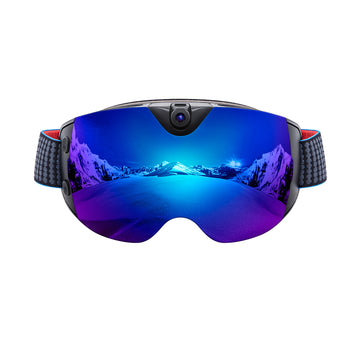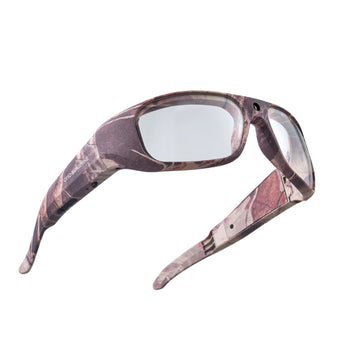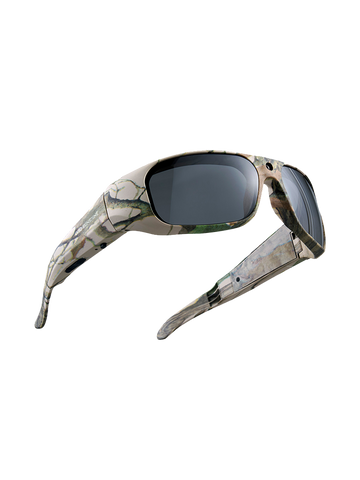

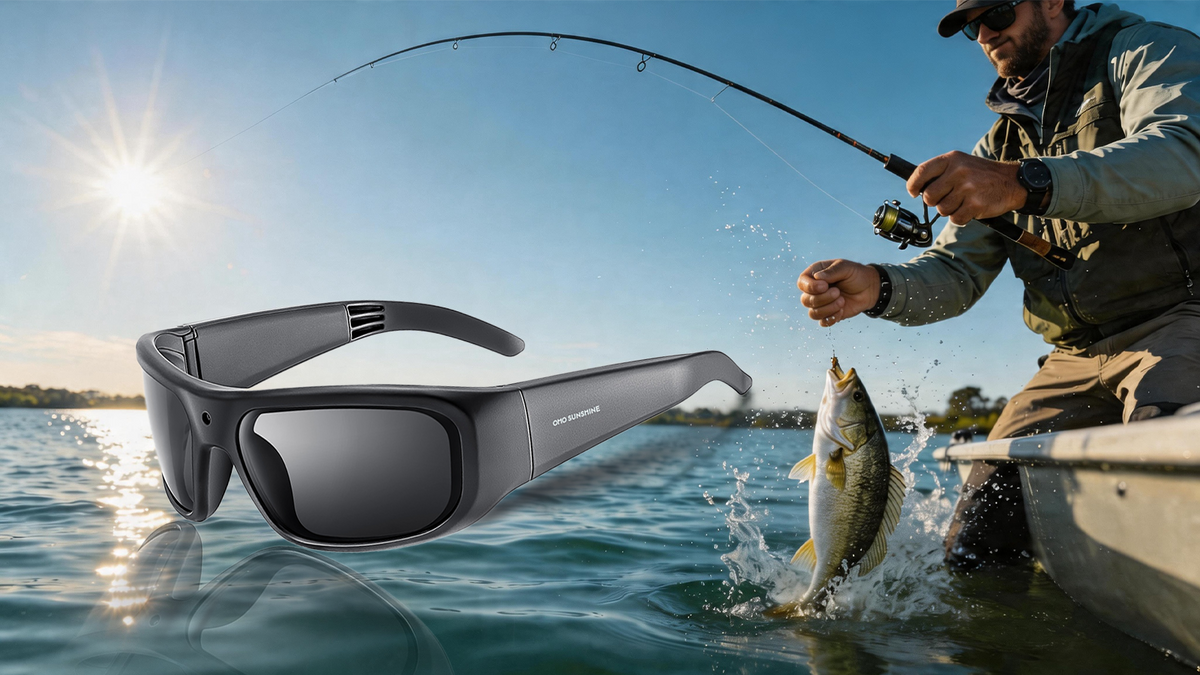
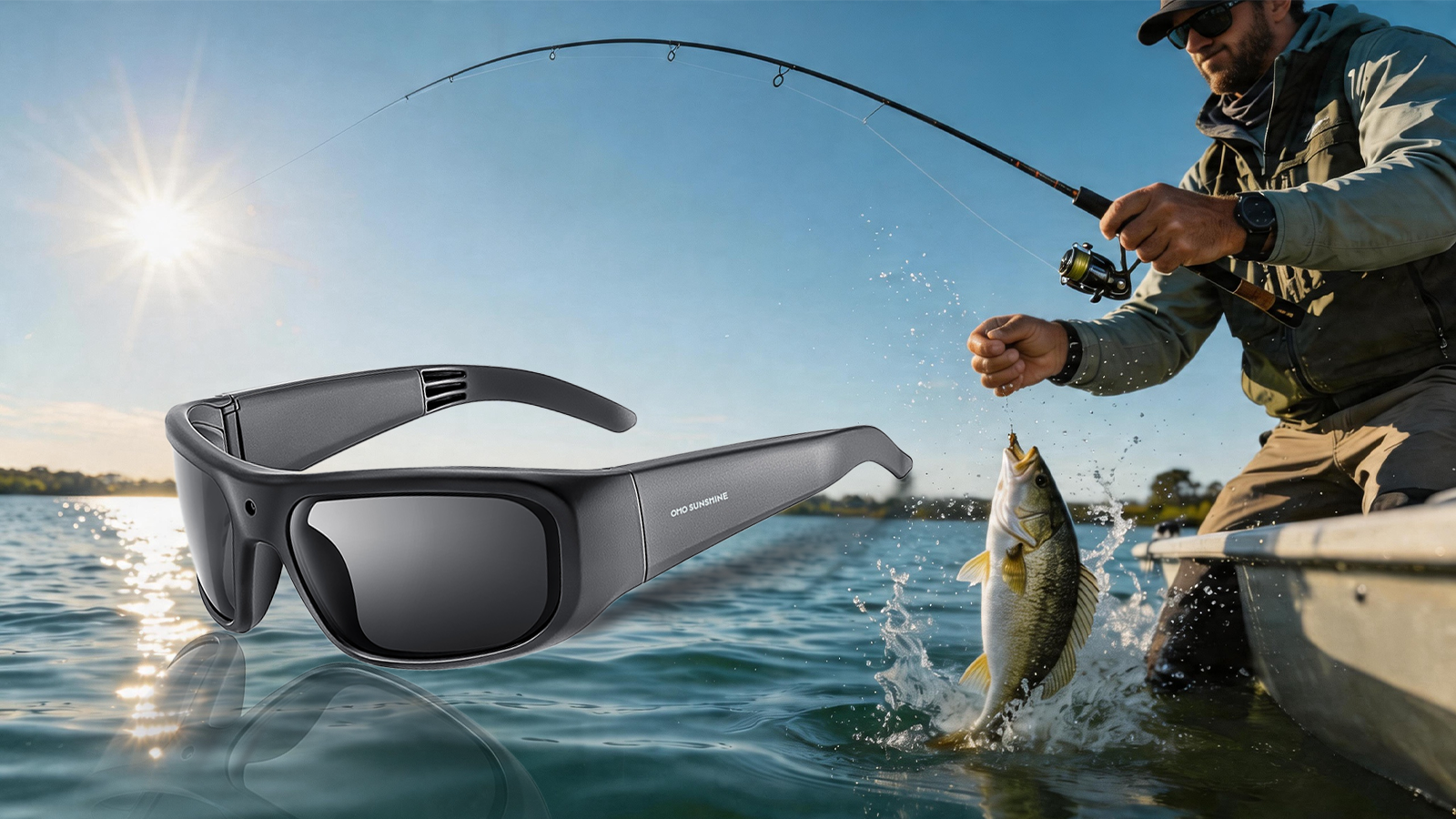
Every angler knows the frustration: the sun is blazing, you cannot see past the surface glare, and the moment you finally hook a fish, both hands are too busy to grab a camera. Fishing sunglasses with built-in cameras solve both problems at once, and serious anglers are taking notice. Polarized lenses cut through glare, UV400 protection keeps your eyes safe, and a discreet camera captures every catch from exactly your point of view.

Polarized Sunglasses Cut Glare and Help You See Deeper
Glare is not just uncomfortable. On the water, it is a genuine obstacle that hides fish, structure, and depth. Polarized sunglasses are built specifically to deal with it.
How Glare Affects Visibility When Fishing
When sunlight hits a flat surface like a lake or river, the reflected light bounces back in a single horizontal direction. This creates the blinding glare that washes out everything below the surface. Without protection, you cannot spot fish, read the water depth, or identify structure beneath the surface.
The table below shows how glare affects fishing visibility under different light conditions, and what polarized lenses do about it.
| Light Condition | Without Polarization | With Polarization |
| Open water, sunny day | Heavy glare, hard to see below surface | Glare blocked, clearer underwater view |
| Overcast or cloudy | Mild glare, some eye strain | Reduced diffuse glare, more contrast |
| Near-surface vegetation | Reflection hides structure | Reflection cut, structure visible |
| Early morning or golden hour | Low-angle glare is intense | Horizontal glare filtered effectively |
Glare does not just strain your eyes. It actively hides the information you need to fish well.
What Polarized Lenses Actually Do
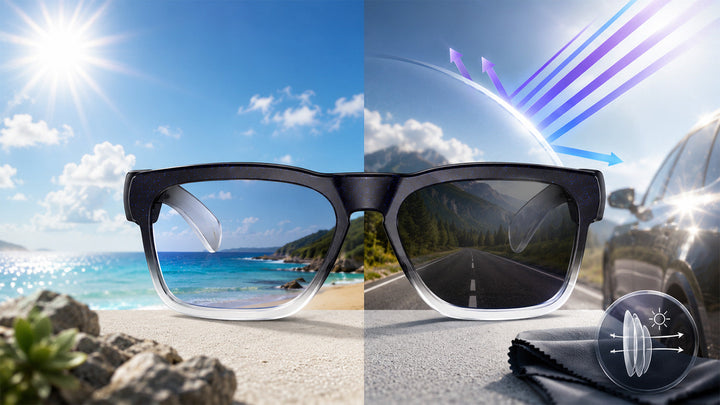
A polarized lens contains a special chemical filter that blocks horizontally oriented light waves. Since water glare travels horizontally, the filter cuts it out almost entirely. The result is a much clearer view of what is below the surface.
For fishing, this means you can see fish moving in shallow water, spot underwater structure, and track bait more accurately. Polarized sunglasses do not just make fishing more comfortable. They make you a more effective angler.
Camera Sunglasses Keep Both Hands Free When Fishing
The built-in camera is what separates fishing camera sunglasses from any other pair of polarized sunglasses. For anglers, this feature solves a problem that has never had a clean answer: how do you record a catch when both hands are full?
Why Hands-Free Recording Matters While Fishing
Fishing demands full physical attention from the moment a fish bites. Your rod hand is managing tension, your other hand is on the reel, and your eyes are locked on the water. Setting down the rod to grab a recording device is not realistic, and asking a fishing buddy to film every catch is not always an option.
Camera sunglasses record automatically from your point of view. Once you start recording with a single button press, the glasses capture exactly what you see, in real time, with no extra steps. The POV (point-of-view) angle is particularly well-suited to fishing because it naturally frames the rod, the water, the fight, and the catch all together.
What the Camera Feature Delivers
The camera built into fishing sunglasses does more than just record. Here is what makes the format work so well for anglers:
- True first-person footage: The lens sits where your eyes are, so the video angle matches exactly what the angler experienced.
- One-button operation: Recording starts and stops with a single press, which means you never need to look away from the water.
- LED indicator: A small flashing light confirms the camera is actively recording, so you always know the footage is running without checking a screen.
- Photo capture: Most models also support still photography, so you can take a clean shot of the catch without switching devices.
- Changeable lenses: Some models allow lens swaps, so you can switch between polarized, clear, or tinted options depending on lighting conditions.
- Easy file transfer: Footage transfers to a phone, tablet, or computer via USB connection for quick sharing or editing.
For anglers who document their catches, post trip content, or want to study their own technique, the built-in camera makes all of that possible without any additional gear on the water.
Video Quality and What to Look For
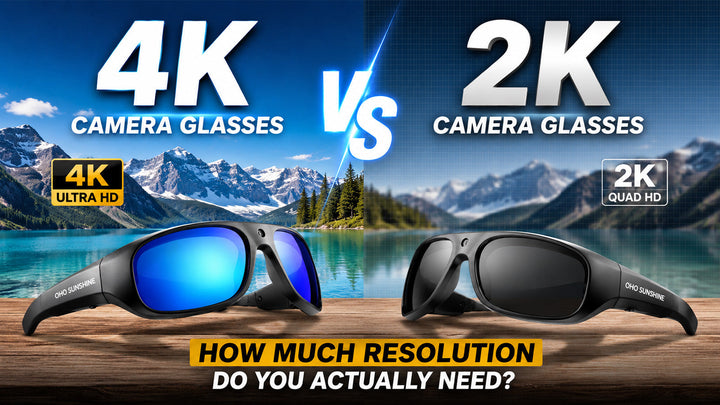
Camera quality in fishing sunglasses has improved significantly. Higher resolution options capture more detail in fast-moving scenes, which matters when you are filming a fish breaking the surface or a quick-release. Look for models that record at full HD (1080p) at a minimum. Higher resolution options deliver noticeably sharper footage, especially when the video is viewed on a larger screen or trimmed for social media.
High-resolution photo capture is also worth considering. A 24-megapixel still camera built into the frame means you can take a clean photo of the catch at full quality, not just a screenshot from video footage.
Waterproof Fishing Sunglasses Hold Up in Any Condition
The water is a tough environment for any gear. Fishing sunglasses need to handle more than just light. They need to survive the conditions that come with a full day on the water.
Water Resistance Ratings Explained
Not all water-resistant products offer the same level of protection. The most common standard used for wearable gear is ATM rating. ATM stands for atmospheres, a unit that measures water pressure resistance. Higher ATM ratings mean the product can handle deeper and longer exposure to water.
For fishing sunglasses, water resistance matters in several practical ways:
- Splash and rain protection: Keeps the lens clear and the internal components safe when waves hit or rain falls.
- Sweat resistance: Relevant on hot days or during active casting sessions.
- Accidental submersion: Glasses that fall into shallow water can often be retrieved and used without damage.
- Easy cleaning: Water-resistant frames can be rinsed off after saltwater or muddy conditions without concern.
Frame and Lens Materials That Last
Durability also comes down to what the glasses are made of. Lightweight, flexible materials like TR90, a thermoplastic used in premium eyewear, are popular because they bend without cracking and return to shape after impact. For lenses, scratch-resistant coatings are important since fishing gear takes consistent physical abuse from hooks, lines, cases, and the environment.
Salt, UV exposure, humidity, and physical impact all wear down materials over time. Fishing sunglasses built for the marine environment are designed to hold up under exactly these conditions across many seasons of use.
UV400 Polarized Sunglasses Protect Your Eyes All Day
Glare reduction is only part of what fishing sunglasses should do. Long hours outdoors mean serious UV exposure, and the eyes are one of the most vulnerable areas on the body.
What UV400 Means
UV400 is a protection standard indicating that a lens blocks all ultraviolet light up to 400 nanometers in wavelength. This covers both UVA and UVB rays completely. UVA rays penetrate deep and are linked to long-term eye damage, while UVB rays cause more immediate harm like surface-level eye sunburn.
Some sunglasses darken the lens without actually blocking UV radiation. This can be counterproductive, because a dark tint causes your pupils to dilate, letting in more harmful rays. UV400 certification means the lens has been tested and verified to block the full spectrum of UV light.

Why Fishing Trips Demand Full UV Protection
Water reflects UV rays back upward, which means anglers are exposed from two directions at once: directly from the sun above and as a reflection off the surface below. This significantly increases the total UV exposure compared to being on dry land.
Spending hours on the water without proper protection raises the risk of photokeratitis (a sunburn of the eye's surface), long-term retinal damage, and accelerated development of cataracts. UV400 polarized sunglasses address both the glare problem and the UV problem in a single lens, which is why they have become the standard choice for serious anglers.
Level Up Every Fishing Trip
Polarized lenses sharpen your vision through glare, a built-in camera captures every catch hands-free, waterproof construction handles the tough conditions that come with real fishing, and UV400 protection keeps your eyes safe through long days of sun. For anglers who spend serious time on the water, camera sunglasses with polarized UV400 lenses cover all of that in one lightweight frame. Find the pair that fits your fishing style and start recording the catches worth remembering.
FAQs about Fishing Sunglasses
Q1. Why Are Polarized Lenses Better for Fishing Than Regular Sunglasses?
Regular tinted lenses reduce overall brightness but are not designed to address the horizontal glare that reflects off water. Polarized lenses contain a directional filter that specifically blocks that reflected light, giving you a clearer view below the surface. For fishing, this means you can spot fish, structure, and bait that would otherwise stay hidden behind the glare.
Q2. Can Camera Sunglasses Handle Water Splashes?
Most camera sunglasses designed for outdoor sports include water resistance as a standard feature. The level of protection varies by model, typically indicated by an ATM or IPX rating. For casual fishing with splashes and light rain, standard water-resistant models perform well. If you fish in heavier spray, wade regularly, or kayak, look for a model with a higher waterproof rating to match those conditions.
Q3. Do Fishing Sunglasses Provide UV400 Protection?
Not all fishing sunglasses include UV400 protection, so it is worth confirming when choosing a pair. UV400 means the lenses block all ultraviolet light up to 400 nanometers, covering both UVA and UVB rays fully. Since water reflects UV radiation from below as well, full UV400 protection is especially important for anglers spending extended time outdoors.