



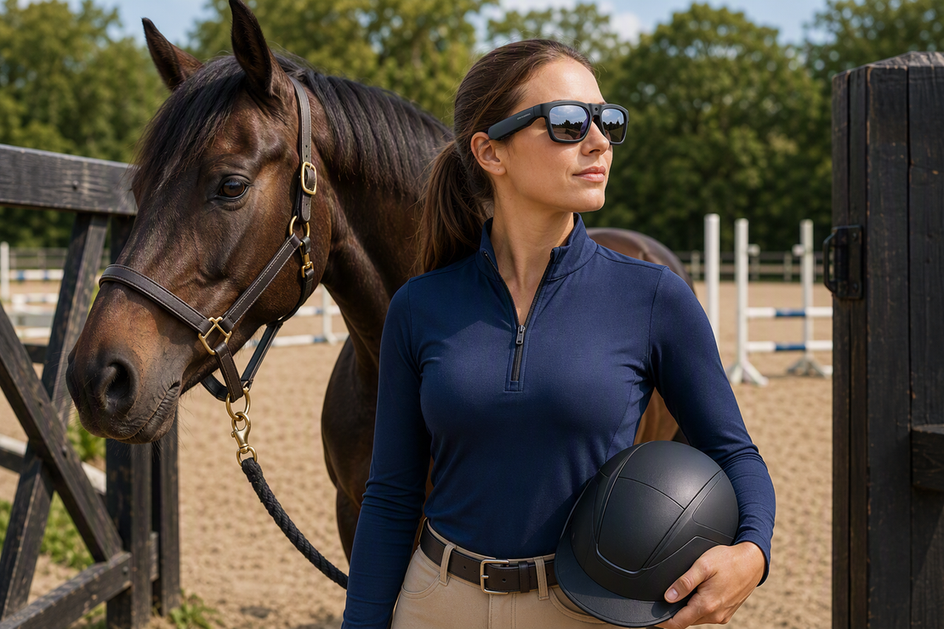
Video camera sunglasses can work under a riding helmet, but only when the helmet still sits level, snug, and fully fastened once the glasses are on. The deciding factors are temple-arm clearance, an absence of pressure points, and whether the camera stays aligned once your horse starts moving. Testing this progressively, from a stationary check through walk, trot, canter, trail riding, and jumping, tells you more than a resolution spec ever will.
Can Camera Glasses Fit Under a Riding Helmet?
Camera glasses pass the helmet-fit test only when the helmet keeps its normal, secure seating once they are on. Any localized temple pressure, independent movement, or blocked vision is a sign to stop and refit before you ride forward.

Check Temple Clearance With the Helmet Fitted Normally
Run this sequence every time you try a new pair of camera glasses with your riding helmet:
- Put the glasses on first, then fit the helmet exactly as you normally would. Do not loosen the harness or reposition the helmet to make room for the temple arms.
- Feel along both temples for a sharp or localized pressure point, and check that the nose bridge still sits comfortably.
- Move your head side to side and up and down while standing still. The helmet and glasses should move together, not independently, and your vision should stay clear.
- If anything shifts, pinches, or blocks your sightline, treat it as a fail and try a different frame width or helmet adjustment. Our smart glasses fit guide walks through bridge contact and temple pressure checks in more depth, though it is not written for equestrian helmets specifically, so treat it as a general fit reference rather than proof of compatibility with your model.
Use a Progressive Fit Test Before Mounting
Once the stationary check passes, sit in the saddle for a few minutes before you ask your horse to move. Watch for pressure building up, a headache starting, the glasses sliding, or the helmet's fit changing as you settle into position. If any of that happens, stop and refit rather than continuing, and never loosen the helmet to relieve pressure from the glasses; a properly fitted riding helmet needs to stay snug and level for its harness to do its job, according to guidance from the properly fitted riding helmet fitting standards used by equestrian safety educators. Passing this stage is a conditional green light for the next test, not confirmation that the setup is ready for a full lesson, a trail ride, or a jumping course.
How Stable Is First-Person Video While Riding?
First-person footage only stays usable when the glasses stop shifting as your horse's gait changes. Testing framing at each riding stage, then matching the model to the actual recording job, keeps this decision grounded in what riding requires rather than in a spec sheet.

Separate Camera Alignment From Movement Stability
Physical fit and footage quality are two different questions, so test them in this order:
- Record a short clip while standing still and check that the framing points where you expect it to, roughly along your natural eyeline.
- Walk your horse for a minute and review the clip for tilt, drift, or a helmet that has shifted position.
- Repeat at trot, then canter, then on a short trail stretch, and only add jumping once the earlier stages hold steady.
- Note at each stage whether the footage is aligned, shifted, uncomfortable, or unusable, and stop advancing to the next gait if a stage fails. Our guides on image stabilization for walking video and 4K camera glasses testing cover useful motion and file checks, but neither was tested on horseback, so use them for method, not for a riding-specific pass.
Match the Glasses to the Recording Job
Once fit and framing pass, three supported OHO SUNSHINE models cover different jobs. The table below uses only their listed specifications.
| Model | Camera & Smart Function | Listed Weight & Battery | Best-Supported Use |
|---|---|---|---|
| Edge Pro | 4K/30 fps video, real-time translation, Bluetooth 5.3 | 41.5 g; 1.5–20 hr battery working-time range | Camera plus translation or Bluetooth for longer sessions |
| Brave | 4K/30 fps video, built-in microphone, polarized UV400 lenses | 60 g; 30-minute battery life | Camera-first footage for a short school or trail loop |
| GlobeEar | Bluetooth audio, AI translation, no listed camera mode | 39 g; 10-hour battery | Audio or translation only, not video |
If your priority is a first-person clip alongside real-time translation and Bluetooth audio, our Edge Pro camera glasses record at a listed 4K/30 fps and carry a 1.5–20 hour battery working-time range, though that span reflects mixed feature use rather than a guaranteed continuous 4K recording time. Riders who want camera-first footage for a short school session or a quick trail loop can consider our Brave 4K camera glasses, which list the same 4K/30 fps resolution, a built-in microphone, and polarized UV400 lenses, but only a 30-minute battery figure and the heaviest frame of the three at 60 grams, so plan short clips or a recharge break into your ride. When the actual job is audio or translation rather than filming your ride, our GlobeEar Bluetooth glasses list 10 hours of battery life and multilingual translation at a lighter 39 grams, but the supplied specifications do not include a camera or video mode, so it is not the right choice for jumping or trail footage. If none of these three matches your weight or battery tolerance, our camera glasses collection lists the current lineup by resolution and lens type so you can compare beyond these three.
Passing the fit and gait tests still does not settle whether you can wear the setup in competition. USEF's rule for licensed competitions requires mounted riders to wear a USEF headgear requirement that stays properly fitted and fastened, so nothing worn underneath it, including camera glasses, can be allowed to loosen that fit. USEF has also confirmed through its organizer camera policy that the association itself does not prohibit helmet cameras, but any individual competition organizer may ban them, and riding with one remains voluntary and at the rider's own risk. Schooling success with your setup does not establish show permission; check the specific event's rule before you compete.
One more practical constraint can still make a tested setup unsuitable for a full ride: runtime. If your recording purpose needs continuous footage longer than a model's listed battery figure, plan a recharge, shorten the recording window, or choose a different model rather than assuming the setup will simply keep working.
FAQs
Can I wear prescription glasses with camera glasses under a riding helmet?
Prescription compatibility is model-specific, and the supplied listings for the camera-focused models here do not confirm wearing them over separate prescription eyewear. Check your exact model's lens options and rerun the full helmet-and-glasses fit test with your own prescription glasses in place before relying on the combination.
Does 4K automatically mean smoother riding footage?
No. A 4K rating describes recording resolution, not whether the footage stays steady or well-framed while your horse moves. Review a short test clip at your intended gait, as described in the stability section above, before deciding a model works for your riding.
How should I plan battery life for a longer trail ride?
Match the listed figures to your session: Brave is listed at 30 minutes, which suits short clips only; Edge Pro's 1.5–20 hour range covers mixed feature use rather than guaranteed continuous 4K recording; and GlobeEar's 10-hour figure applies to its Bluetooth and translation functions, not video. Test actual recording duration on your own device before a full trail ride.
Fit the helmet as usual first, then progress from a stationary check to walk, trot, canter, trail, and jumping before trusting any setup for a full ride. Match the camera glasses to the job: camera-first, camera-plus-translation, or audio-only. Once fit and footage both pass, confirm your specific event's camera and headgear rules before you compete. We're glad to help you compare our smart glasses lineup for your next ride.


留言
此網站已受到 hCaptcha 保護,且適用 hCaptcha 隱私政策以及服務條款。